 Getting Job-ed
Now, everyone may be asking, “Did Austin just speak in a different language?” No, and it sounds very high-level theological and nerdy (it definitely can get that way!), but postmillennialism is another view in theology in the realm of eschatology. What’s eschatology? To make it easy, it’s the study of things about the end (literally in the name, the study of end things). How does this story pan out? How does the end of the world come about? When is Jesus’ return? What is the trajectory for the Church and for mankind? All of that, and much more. Truly, eschatology is not just found in the Book of Revelation but rather started in the Book of Genesis and is the progressive, unfolding nature of the biblical narrative throughout all of Scripture. So a good question to ask when reading the Bible is: where is this story going, and what’s the trajectory of it? That’s eschatology. Just like anything in theology, there are different camps of people that define the beliefs they hold (and good Christians that disagree, and yet are still brothers and sisters!). The camp I come from is postmillennialism. So let me try to lay some foundation work for you in this article. Hopefully, through this series, I’ll be able to at least give a reason why I am one of the crazy postmill guys (we’re on a first-name basis with using “postmill” now). So, why do I believe in postmillennialism? Here goes.
First, Why Are You Talking About the “End of Times?”
Well, if you haven’t noticed, the “end of times” is a huge discussion in the Christian world. Unrest in the Middle East, blood moons, the Book of Revelation, the antichrist, cryptocurrency, Marxist ideologies, credit cards, persecution of Christians, pictures of Jesus in the clouds, the mark of the beast, red heifers, etc., always keep the discussion alive in the Christian circle. Needless to say, much-needed clarity and perspective could be had on all of these “prophetic” events that are “unfolding before our eyes.” What if there are different perspectives on these so-called Bible prophecies coming to life? I think it’s definitely worth the discussion.
But what does this have to do with the Getting Job-ed ministry? Well, our eschatological view can influence the way we view suffering in the Christian life, and also influence our perspective of what the overall trajectory of the Biblical narrative is. This should force us to ask questions about our individual end (of life) and also how this whole story pans out. We’ll go briefly through the major perspectives on eschatology, which will give some differing perspectives on this based on their stance.
*Note to my fellow theology nerds: these articles are not going to go into detail of interpretive strategies such as preterism, partial-preterism, futurism, etc. We’re keeping it high-level overview. My views on this come out in other teachings I’ve done on passages such as Matthew 24.
Let’s Define the Different Camps of Eschatology
We’re going to make this brief. If you want an in-depth study on each of these, the resources can outnumber the stars. So I want to keep this simple and give a high-level overview of the different views. I can honestly say I’ve been each one at different times in my Christian walk. So, I can speak to each, and I don’t want to straw-man anyone by doing injustice to them. I have my sympathies for each because I’ve been there and wrestled with them!
Each of these four camps define their view by the relationship of the return of Christ and where that event stands in light of His thousand-year reign in Revelation 20. Does Jesus someday return and then establish His thousand-year reign? That would be the premillennial view (Christ returns BEFORE the thousand-year reign begins). Is Christ’s thousand-year reign happening right now, and then He will return later? That could be either postmillennial or amillennial (Christ returns AFTER the “thousand-year” reign). What is the nature of His reign during the “thousand-year” period? That would be the difference between amillenial and postmillennial. Here is an extremely brief breakdown of each
Dispensational Premillennialism
Christ returns before His thousand-year reign (hence premill). A “secret” return of Christ happens (Jesus raptures His believers to Himself), which then issues in a time of tribulation for the rest of those left behind (thus the popular book series titled Left Behind, which is a dispensational view of Christ’s second coming in a fictitious set of literature, super popular in the 90’s, eat your heart out Kirk Cameron). Has a literal view of the “thousand-year” reign. Literal (aka word-for-word) understanding of Old Testament and New Testament prophecies. Tribulation for Christians will get worse over time until Christ’s return. Israel and the Church are two separate entities (prophecies for Israel are for Israel only and not the Church). Possibly the most popular view in eschatology today, especially since the Israeli state became established in the mid 1900’s. This view takes a more negative view of history: since Jesus’ first coming, history will always be progressively getting more hostile toward believers. Dispensationalists tend to have the bible in one hand and a newspaper in the other when looking at prophecy.
Historic Premillennialism
Christ returns before His thousand-year reign (premill). Related in timing to dispensational premill, but is significantly different. The thousand-year reign could either be literal or figurative (depending on who you talk to) (1). Not as a “word-for-word” interpretation of Old Testament and New Testament prophecies as dispensational, but more than amill and postmill. High regard for Israel, especially in view of Old Testament prophecies (do not always transfer over to the Church in fulfillment, but sometimes do, depending on who you talk to). Believe in a literal reign of Christ. Allows room for figurative, hyperbolic imagery of prophecies, more so than dispensational premill. Again, this view takes a more negative view of history: since Jesus’ first coming, history will always be progressively getting more hostile toward believers.
Amillennialism
Literally means “no” millennia, but that’s not necessarily the case. Believes in a spiritual reign of Christ right now with the believers who have passed away. The “church age” that we are currently in would be how they describe the millenia, with Jesus’ return after the “church age.” Highly favorable to the saying “already but not yet” approach to Jesus’ reign and the Kingdom of God for today. Can have a positive or negative view of history, either favoring or getting worse for Christ’s believers (most amill’s that I know have a negative view of the progress of history in relationship to believers, but some would ID themselves as “optimistic amill”).
Postmillenialism
Postmill says that Christ’s return will come at the end of the thousand-year reign, which they would say is a symbolic length of time (typically a VERY long period of time). Currently, the “church age” that we live in would be synonymous with Christ’s thousand-year reign until His return, which will bring about the eternal state (New Heavens/New Earth, with some variations). Postmill sides with both premill and amill on certain aspects. With premill, the postmill’s love the concept of Christ’s reign being a very real reality (not just a spiritual reign, but a reign that is happening amongst His people in this reality). With amill, the postmills love the concept that we are currently in the church age/millennia. However, the post mill’s differences with the other camps are real. With premill, the postmills differ in the timing of the return of Christ, and we believe that He is ruling and reigning right now in a very real sense with His believers on earth. With amill, the post mill’s differ on the reality of the reign of Christ right now in that He truly is ruling and reigning not just in a spiritual realm but with His believers on earth (sometimes the “already but not yet” means “already but not really,” this is definitely taken from Jeff Durbin, but I have no idea what lecture I heard this from, but it definitely rang out to me). The postmills believe that Jesus is ruling and reigning through the lives of His followers and that the gospel will be successful in its mission to make disciples of all nations (Matthew 28:18-20). This eschatological view is more favorable toward history for believers in Christ, but it does leave room for tribulation and persecution on the road to success.
Obviously, just a few paragraphs could not do justice in trying to explain the differences in these camps of eschatology. Still, the goal was to give a thousand-foot overview (symbolic usage of the term, my theological nerds will understand) of them. One could not begin to count the millions of gallons of ink spilled in order to convey their views of the end of times! So I will not try. I truly didn’t want to straw-man the other perspectives. So, if you want to learn more about the other perspectives, go check them out. There are amazing and faithful teachers who hold these different views. Some of which have been absolutely instrumental in my faith. As I’ve said, I’m sympathetic toward the different views because I have literally been across the spectrum in each of their camps! My goal is to merely show why this theological view has appealed to me and why I think it could help people endure suffering.
The Kingdom of God
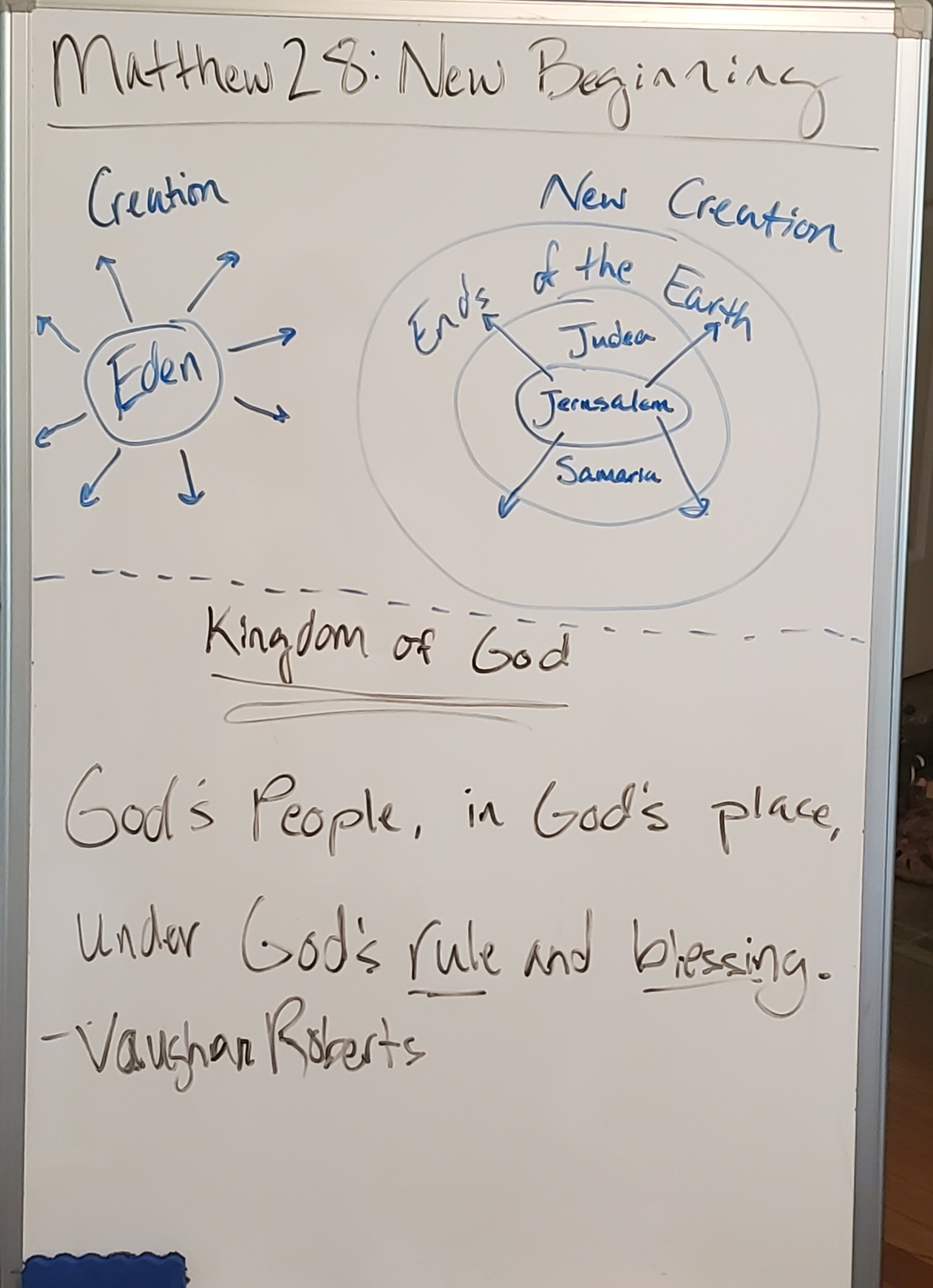
Perhaps one of the most convincing pieces of Postmill eschatology is the Kingdom of God. Now, all other perspectives have a concept of the Kingdom of God. So, what’s unique about the postmill perspective? I think it’d be better to explain my prior views of the Kingdom of God. The Kingdom of God was always a confusing topic for me prior to my schooling. Is it heaven? Is it the New Heavens and New Earth (Revelation 21-22)? Is it the future? Is it now? So, like with most things that confuse us, what do we do? Ignore it. But then my first class of my master’s explained that the kingdom of God is simple: God’s people, in God’s place, under God’s rule and blessing (2). That was a huge eye-opener for me, and then it’s like I couldn’t help but see it in Scripture.
Now that’s not unique to the postmill position. So, what is? Remember how I stated it prior: the timing of Christ’s rule and reign and the nature of His reign. Christ’s reign is right now, not just in a spiritual sense, but in a very real sense in our reality. Does Scripture shed its light on this?
Timing of His Rule and Reign
Matthew 12:22-28 ESV (emphasis added):
Then a demon-oppressed man who was blind and mute was brought to him, and he healed him, so that the man spoke and saw. And all the people were amazed, and said, “Can this be the Son of David?” But when the Pharisees heard it, they said, “It is only by Beelzebul, the prince of demons, that this man casts out demons.” Knowing their thoughts, he said to them, “Every kingdom divided against itself is laid waste, and no city or house divided against itself will stand. And if Satan casts out Satan, he is divided against himself. How then will his kingdom stand? And if I cast out demons by Beelzebul, by whom do your sons cast them out? Therefore they will be your judges. But if it is by the Spirit of God that I cast out demons, then the kingdom of God has come upon you.
Notice the tense of the word above. The logic flows like this: Jesus is not casting out demons by Satan, but since it is by the power of God and His Spirit, then the Kingdom of God HAS come upon you. HAS come, currently and presently, the kingdom of God has come with Jesus’ coming! Not a future reality, but a reality for us.
The Great Commission helps flesh this out as well. Matthew 28:18-20 LSB (emphasis added):
And Jesus came up and spoke to them, saying, “All authority has been given to Me in heaven and on earth. Go therefore and make disciples of all the nations, baptizing them in the name of the Father and the Son and the Holy Spirit, teaching them to keep all that I commanded you; and behold, I am with you always, even to the end of the age.”
Here Jesus says that ALL authority has been given to Him, both in heaven and on earth. That means that He was reigning then and is currently reigning now. Then He goes on to give the Great Commission for His followers: go make disciples of all nations. But note the subtlety in this by the word “therefore.” “Therefore” (or οὖν in the Greek) is a conjunction pulling together the preceding thought. Jesus, in a way, is saying, “Because all authority has been given to me, I now commission and command you to go out and make disciples.” The Great Commission is predicated on all authority having been given to Jesus; all authority being given to Him is the basis by which He makes the Great Commission. This is important: the Great Commission command hinges on the authority that has been given to Jesus. It’s because Jesus reigns right now that He has the authority and power to make this command and to see to it that the command will be carried out by His followers.
The Nature of His Reign
What would it mean for King Jesus to be ruling right now? Remember our definition above of what the Kingdom of God is: God’s people, in God’s place, under God’s rule and blessing (2). For Jesus to be the King and to be ruling right now would mean for Him to be conquering all of His enemies, subduing the world, and extending His reign to the ends of the world.
Now, some of this we will talk about in a later part, but look at the Great Commission above. The Great Commission in Matthew 28:18-20 is just a recapitulation of the command given to Adam in Genesis 1:27-28 LSB:
And God created man in His own image, in the image of God He created him; male and female He created them. God blessed them, and God said to them, “Be fruitful and multiply, and fill the earth, and subdue it…”
See the similarities. God, the King, commands mankind to take His image into the world and make other image bearers of God. Then He commands them to subdue the earth. What does that mean? Bring it into order, bring it under their rule, which is to be under God’s rule. What does Jesus command His followers? Jesus commands us to make other image bearers of Christ, and bring them under His rule by saying for His followers to teach them to “…keep all that I have commanded you… “(Matthew 28:20 LSB). Only a present-tense ruling King can make such a command.
Jesus commands that His followers go out and conquer the world through His Gospel, and this coincides with what was expected of Jesus’ reign. With different variations, the most quoted Old Testament verse in the New Testament is Psalm 110:1 LSB: “Yahweh says to my Lord: ‘Sit at My right hand until I put Your enemies as a footstool for Your feet.’” The most quoted Old Testament verse in the New Testament expects that Yahweh will take all of the enemies of this “Lord” and put them under His feet (this is a song of David, and from His perspective, Yahweh is saying to this other “Lord” of David… wonder who that could be??). All opposers to Jesus’ rule will bow one way or another: either they will bow in submission, or He will break them in judgment. And this is not something for the future, but is a reality right now, as Paul discusses in 1 Corinthians 15:20-26 LSB:
But now Christ has been raised from the dead, the first fruits of those who have fallen asleep. For since by a man came death, by a man also came the resurrection of the dead. For as in Adam all die, so also in Christ all will be made alive. But each in his own order: Christ the first fruits, after that those who are Christ’s at His coming. Then comes the end, when He hands over the kingdom to the God and Father, when He has abolished all rule and all authority and power. For He must reign UNTIL HE HAS PUT ALL HIS ENEMIES UNDER HIS FEET. The last enemy to be abolished is death.
Is Jesus reigning right now per Matthew 28:18-20? Yes. So if He is reigning now, then Jesus is currently putting all of His enemies under His feet. Jesus’ kingdom is currently spreading and putting His enemies under His feet. We will pick up more on the progressive nature of this rule in a future article.
Rewind Back to 2020
I recall back to 2020 and how big of a mess it was. COVID, vaccines, liberal insanity, all of it. Pastors were being threatened or even being put in jail for not bowing to the government’s unlawful edicts on the church. If you didn’t get the vaccine, you could lose your job (I’m not making a political case here; I didn’t get the vaccine for religious reasons and was threatened with job loss for about 3 months). The threat of needing a vaccine card to go out to restaurants or even to work smelled a whole lot like the “mark of the beast” that I was told about in Revelation. I was not a postmill back then. I’ve got to be honest, things looked pretty grim. I thought for sure that if Jesus was coming back, it was going to be soon. It was a very scary time in the world and for my family and me. We lost some close friends, and relationships with some family members were tainted from that time.
But then, just like that, it was over. Job loss was not an issue (of course, nurses were the essential workers, right? Not all of my nursing friends, sadly…). COVID cards weren’t required anymore. Churches won major lawsuits against the state’s unlawful schemes. Jesus didn’t return on a cloud. Life continued, the end didn’t come. In fact, I would say there is a better sense of “awakening” to the evil that is in the world and a greater openness to sanity (which is really just God’s rule and law). That’s not to say we’re living in heaven on earth, but the temperature feels different than before. Perhaps something good would come from the insanity that shook our country to the core?
This was when my mind was more open to other eschatological viewpoints. What if Jesus were reigning right now and would continue to reign until He puts all of His enemies under His feet? What if Jesus were to extend His rule through the Church by conquering His enemies not with the sword but with His word and the Gospel? These were the questions that began to reshape my thinking on the end of times.
-Austin
- Wayne Grudem, Systematic Theology: An Introduction to Biblical Doctrine, 2nd ed., (Michigan, Zondervan, 2020), 1372.
- Vaughn Roberts, God’s Big Picture, (Illinois: InterVarsity Press, 2002), 22.